Discovery consists of seeing what everybody has seen and thinking what nobody has thought.
-Albert Gyorgyi-

Technology & Computers - Top Blogs Philippines

Famous Inventors

1. Thomas Edison

2. Alexander Graham Bell

3. George Washington Carver

4. Eli Whitney

5. Johannes Gutenberg

6. John Logie Baird

7. Benjamin Franklin

8. Henry Ford

9. James Naismith

10. Herman Hollerith


free counters
Blogger

mechanical tabulator

mechanical tabulator
Herman Hollerith (February 29, 1860 – November 17, 1929) was an American statistician who developed a mechanical tabulator based on punched cards to rapidly tabulate statistics from millions of pieces of data. He was the creator of one of the companies that later combined and became IBM.
Herman Hollerith
Hollerith developed a mechanism using electrical connections to trigger a counter, recording information. A key idea was that data could be coded numerically. Hollerith determined that if numbers could be punched in particular locations on a card, in the now-familiar rows and columns, then the cards could be counted or sorted mechanically and the data recorded. A explanation of this system, An Electric Tabulating System in 1889, was submitted by Hollerith to Columbia University as his doctoral thesis, and is reprinted in Randell's book.

telephone

Alexander Graham Bell
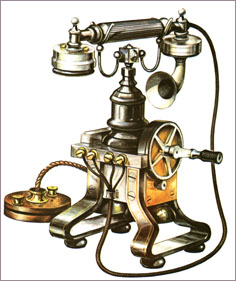
                At the age of 29, Alexander Graham Bell invented his telephone in 1876 and in 1877, he formed the Bell Telephone Company, and in the same year married Mabel Hubbard.
      Alexander Graham Bell might easily have been satisfied with the success of his telephone invention. His many laboratory notebooks show, however, that he was driven by a genuine and rare intellectual curiosity that kept him regularly searching, striving, and wanting always to learn and to create. He would continue to test out new ideas through a long and productive life. He would explore the area of communications as well as keep in a great variety of scientific activities involving kites, airplanes, tetrahedral structures, sheep-breeding, artificial respiration, desalinization and water distillation, and hydrofoils.

carbon microphone

Thomas Edison
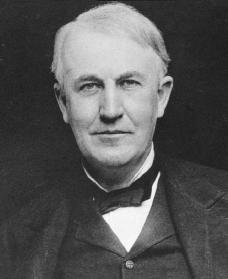
                    Thomas Alva Edison was born on February 11, 1847 in Milan, Ohio, United States and Died October 18, 1931 with the aged of 84. His occupation is inventor, scientist, businessman and his religion is a Deist.
 
                  Thomas Edison began his career as an inventor in Newark, New Jersey, with the automatic repeater and his other improved telegraphic devices, but the invention which first achieve him notice was the phonograph in 1877. This achievement was so unexpected by the public at large as to come out almost magical. Edison became known as The Wizard of Menlo Park, New Jersey. His first phonograph recorded on tinfoil around a ridged cylinder, but had poor sound quality and the recordings could only be played a few times. In the 1880s, a redesigned model using wax-coated cardboard cylinders was created by Alexander Graham Bell, Chichester Bell, and Charles Tainter. This was one reason that Thomas Edison continued work on his ownPerfected Phonograph.
                   In 1877–78, Edison invented and developed the carbon microphone used in all telephones along with the Bell receiver until the 1980s. After extended patent proceedings, in 1892 a federal court ruled that Edison and not Emile Berliner was the inventor of the carbon microphone. The carbon microphone was also used in radio broadcasting and public address work through the 1920s.

Fluorescent Lamp

Many Filipinos recognize Agapito Flores as the inventor of the fluorescent lamp, which is the most widely used source of lighting in the world today. The fluorescent lamp supposedly got its name from Flores. Agapito Flores was born in Guiguinto, Bulacan, Philippines on September 28, 1897. He worked as an apprentice in a machine shop and later moved to Tondo, Manila where he trained at a vocational school to become an electrician. It has been reported that Agapito Flores received a French patent for a fluorescent bulb and that the General Electric Company bought Flores' patent rights and manufactured and sold his fluorescent bulb (making millions from it). However, all the inventors named above and more predate Agapito Flores' possible work on any fluorescent bulb. The fluorescent lamp, on the other hand, was not invented in a particular year. It was the product of 79 years of the development of the lighting method that began with the invention of the electric light bulb by Thomas Edison.
fluorescent lamp
Among the other inventors who assert credit for developing the fluorescent lamp were French physicist A. E. Becquerel (1867), Nikola Tesla, Albert Hall (1927), Mark Winsor and Edmund Germer. Andre Claude was French inventor recognized for developing the fluorescent tubular lighting systems. Yet, he was not officially recognized as the inventor of fluorescent lamp. It was reported that the General Electric and Westinghouse obtained Claude's patent rights and developed the fluorescent lamp that we know today.
According to Filipino scientists, fluorescent lamp was not named after Flores. The term fluorescence first cropped up as early as 1852 when English mathematician-physicist George Gabriel Stokes discovered a bright material calledfluorspar, which he coined with escence. The National Academy of Science and Technology also discharge Flores being the inventor of fluorescent lamp as a myth. No scientific report, no valid statement, no rigorous documents can be used to credit Flores for the discovery of the fluorescent lamp. We have tried to correct this misconception, but the media and our textbooks keep using the Flores example, a Filipino scientist wrote in her column at the Philippine Daily Inquirer.
The fluorescent lamps were introduced into the U.S. market in 1938. Still, Filipinos recognize Agapito Flores as the inventor of the product that illuminated the world.

TV REMOTE CONTROL (1955)

Zenith's Eugene Polley - first designed the wireless remote


Zenith's Eugene Polley, first designed the wireless remote that essentially a flashlight. When Zenith discovers that direct sunlight also can change channels on the remote-receptive TVs, the company comes out with a model that uses ultrasound; it lasts into the 1980s, to the disappointment of many a family dog. . The industry then switches to infrared.

Related Posts Plugin for WordPress, Blogger...